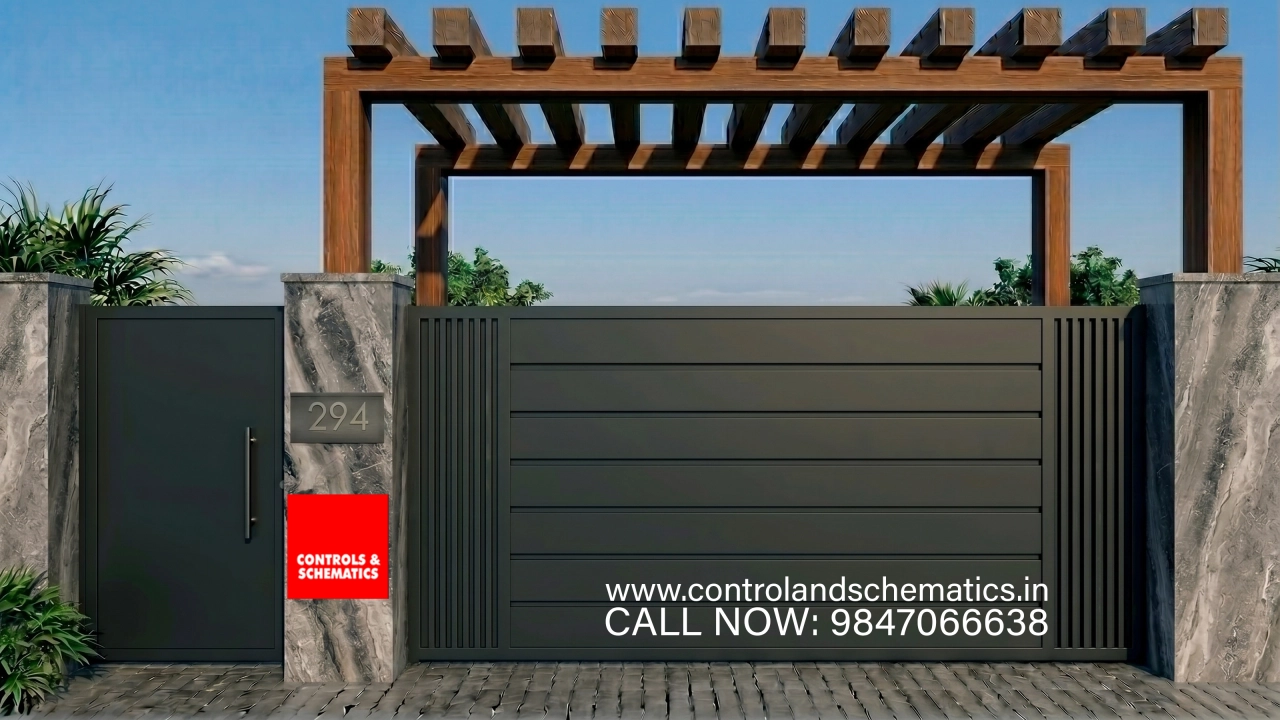
Automatic gates are becoming increasingly popular in Kerala homes, villas, apartments and commercial properties.
Instead of manually opening and closing a heavy entrance gate, an automatic gate allows residents to control access using a remote, keypad, mobile application, intercom or access-control system.
This can be especially convenient during Kerala’s monsoon season, when homeowners may otherwise need to leave their vehicle in heavy rain to open the gate.
However, installing an automatic gate involves more than attaching a motor to an existing gate.
The gate structure, weight, alignment, opening mechanism, electrical wiring, drainage, safety sensors and emergency access must all be planned correctly.
A poorly planned system may become noisy, unreliable or unsafe. It may also place excessive pressure on the motor, hinges, rollers or gate frame.
This guide explains the main types of automatic gate systems for Kerala homes, including sliding and swing gate automation, motor selection, access controls, safety features, power backup, maintenance and planning considerations.
What Is an Automatic Gate System?
An automatic gate system uses an electric motor and control mechanism to open and close an entrance gate.
The system normally includes:
- Gate motor
- Control panel
- Remote controls
- Safety sensors
- Manual-release mechanism
- Limit switches
- Motor rack or operating arms
- Electrical wiring
- Gate stops
- Optional access-control devices
Depending on the installation, the gate can be operated through:
- Handheld remote
- Wall switch
- Keypad
- Mobile application
- Video doorbell
- Intercom
- Access card
- Biometric reader
- Vehicle sensor
- Smart-home system
Automatic gate systems can be installed on sliding gates, swing gates and some specialised folding or telescopic gates.
Why Automatic Gates Are Popular in Kerala
Automatic gates offer convenience, security and controlled access.
Convenience During Rain
Kerala experiences long periods of heavy rain.
An automatic gate allows residents to enter or exit without leaving the vehicle.
This is especially useful for:
- Elderly residents
- Families with children
- People returning late at night
- Homes with long driveways
- Frequently used entrances
Easier Operation of Heavy Gates
Large mild steel or stainless steel gates can be difficult to open manually.
A suitable motor can move the gate smoothly when the frame and hardware are correctly designed.
Improved Access Control
Automatic gates can limit unauthorised entry.
Residents can decide who enters the property using:
- Remote controls
- Intercom confirmation
- Access codes
- Video doorbells
- Mobile access
Better Daily Security
The gate can close automatically after a set period, reducing the possibility of it being left open accidentally.
Support for Smart-Home Integration
Some systems can be connected to:
- CCTV
- Video doorbells
- Mobile applications
- Home automation
- Security alarms
- Visitor-management systems
Suitable for Residential and Commercial Properties
Automatic gate systems can be customised for:
- Individual homes
- Luxury villas
- Apartment entrances
- Offices
- Warehouses
- Schools
- Hospitals
- Resorts
- Commercial properties
Types of Automatic Gate Systems
The right automation system depends mainly on the gate’s opening mechanism.
Automatic Sliding Gates
An automatic sliding gate moves horizontally along the boundary wall.
A motor drives the gate using a toothed rack fixed to the gate frame.
Automatic sliding gates are suitable when:
- The driveway is short
- The property is close to the road
- The entrance is wide
- Inward opening space is limited
- The driveway slopes upward
- The gate is used frequently
Sliding gate automation is common in modern villas and commercial entrances.
Automatic Swing Gates
An automatic swing gate opens using powered arms or underground operators.
The gate may have:
- One large leaf
- Two equal leaves
- Two unequal leaves
Automatic swing gates are suitable when:
- Sufficient inward opening space is available
- Strong gate pillars are present
- The driveway is reasonably level
- A traditional or symmetrical entrance is preferred
Automatic Telescopic Gates
A telescopic gate uses two or more sliding panels that move together and overlap when open.
It is useful when the property does not have enough side space for one full sliding gate panel.
Telescopic systems may be suitable for:
- Compact urban properties
- Wide entrances with limited boundary length
- Commercial entrances
- Modern villas
The system requires accurate installation and quality hardware because multiple panels must move together smoothly.
Automatic Folding Gates
Folding gates use hinged panels that fold as they open.
They may be considered when:
- Side clearance is limited
- Inward space is limited
- A standard sliding gate cannot be accommodated
Automatic folding gates involve more moving joints and may require additional maintenance.
Automatic Cantilever Gates
A cantilever sliding gate moves without a track across the driveway.
The gate is supported by rollers positioned beside the entrance.
This design can be useful in Kerala because it avoids ground tracks that may collect:
- Mud
- Leaves
- Sand
- Rainwater
- Small stones
Cantilever systems usually require:
- Strong foundation
- Additional side space
- Longer gate frame
- Specialised hardware
They are generally more expensive than standard track-based sliding gates.
Sliding Gate Automation: How It Works
A sliding gate motor is normally installed beside the gate.
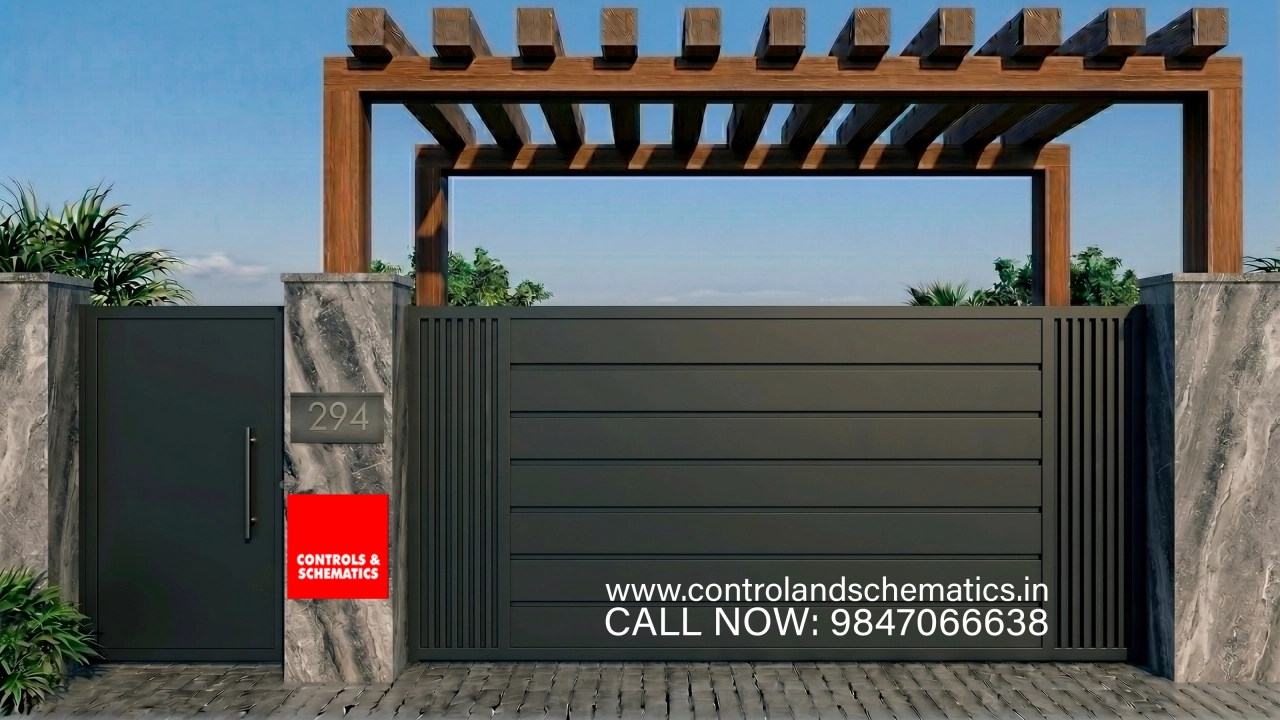
Sliding gate design
A toothed metal or nylon rack is fixed along the lower section of the gate. The motor gear engages with this rack and moves the gate sideways.
The system includes limits that tell the motor when the gate is fully open or closed.
Components of a Sliding Gate System
A typical system may include:
- Sliding gate motor
- Motor foundation
- Gear rack
- Control board
- Remote receiver
- Limit switches
- Safety sensors
- Guide rollers
- Gate stops
- Manual-release key
- Electrical protection
Advantages of Automatic Sliding Gates
- Saves driveway space
- Suitable for wide entrances
- Works well on upward-sloping driveways
- Can support heavy gates
- Convenient for frequent use
- Well suited to modern architecture
- Usually straightforward to automate
Limitations of Automatic Sliding Gates
- Requires enough side clearance
- Track systems need regular cleaning
- Poor drainage can affect operation
- Weak frames can bend
- Low-quality rollers can become noisy
- Motor foundation must remain stable
Swing Gate Automation: How It Works
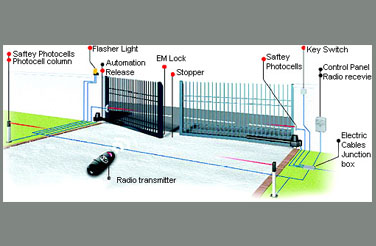
Swing gate automation uses powered mechanisms connected to the gate leaves.
The most common systems include:
- Linear arm motors
- Articulated arm motors
- Underground motors
The correct option depends on gate weight, pillar size, hinge position and opening angle.
Linear Arm Motors
Linear arms extend and retract to move the gate.
They are commonly used when:
- Gate pillars are narrow
- Hinges are positioned close to the inner edge
- The gate has a standard opening angle
- A visible arm is acceptable
Advantages include:
- Common installation method
- Suitable for many residential gates
- Relatively simple mechanism
- Good control of gate movement
Articulated Arm Motors
Articulated motors use folding arms.
They are useful when:
- Gate pillars are wide
- Hinges are set far back
- Linear motors cannot achieve the required geometry
- Additional movement flexibility is needed
The arms remain visible when the gate is closed.
Underground Swing Gate Motors
Underground motors are installed below the gate hinge area.
They provide a cleaner appearance because most of the mechanism is concealed.
They may suit:
- Luxury villas
- Heritage entrances
- Premium architectural gates
- Properties where visible motors are undesirable
However, underground systems require:
- Excellent drainage
- Waterproofing
- Accurate installation
- Accessible maintenance points
Because Kerala receives heavy rain, water management is especially important.
Advantages of Automatic Swing Gates
- Suitable for traditional and modern designs
- Does not require side clearance
- Can preserve symmetrical entrance appearance
- Multiple motor options available
- Works well for double-leaf gates
Limitations of Automatic Swing Gates
- Requires driveway opening space
- Can be affected by slopes
- Strong wind places pressure on gate leaves
- Pillars and hinges must be strong
- Two motors may be required for double gates
- Opening and closing may take more space
Choosing the Right Gate Motor
The motor should be selected based on actual engineering requirements rather than only price.
Important factors include:
- Gate weight
- Gate length
- Opening frequency
- Sliding or swing mechanism
- Wind exposure
- Solid or open gate design
- Motor duty cycle
- Gate balance
- Power supply
- Automation accessories
Gate Weight
The motor must be rated to handle more than the gate’s actual operational load.
A heavy gate with poor rollers or misaligned hinges places additional stress on the motor.
The motor should not be used to compensate for a gate that is structurally difficult to move.
Before automation, the gate should operate smoothly by hand.
Gate Length
Long sliding gates create greater leverage and may require stronger motors and frames.
Wide swing gate leaves also place additional load on motors and hinges.
Frequency of Use
A gate used four times per day has different requirements from an apartment or office gate used dozens of times every hour.
Motor systems may be designed for:
- Light residential use
- Regular residential use
- High-frequency use
- Commercial use
- Continuous or intensive use
The motor’s duty cycle should match the expected usage.
Solid vs Open Gate Design
A solid gate experiences more wind pressure than an open or slatted gate.
Wind load can place additional strain on:
- Motors
- Hinges
- Rollers
- Guide systems
- Pillars
- Locks
This should be considered when choosing the motor and frame.
Motor Quality and Service Support
The motor should have:
- Reliable control system
- Suitable load rating
- Manual release
- Safety-sensor compatibility
- Weather protection
- Available spare parts
- Local technical support
- Clear warranty terms
A low-cost motor without service support can become expensive if replacement parts are difficult to obtain.
Can an Existing Manual Gate Be Automated?
In many cases, an existing gate can be converted to automatic operation.
However, the gate must first be inspected.
The fabricator or automation technician should check:
- Frame strength
- Gate alignment
- Hinges
- Wheels
- Track condition
- Pillar strength
- Bottom clearance
- Side clearance
- Gate weight
- Opening space
- Electrical access
Existing Sliding Gate Assessment
Before automation, confirm that the gate:
- Moves smoothly by hand
- Does not bend
- Has a level track
- Has strong guide rollers
- Does not jump off the track
- Has suitable motor-mounting space
- Has a secure closing post
Existing Swing Gate Assessment
Confirm that the gate:
- Opens smoothly
- Does not sag
- Has strong hinges
- Has rigid pillars
- Does not scrape the ground
- Has suitable motor-arm geometry
- Has strong opening and closing stops
A motor should not be installed on a damaged or poorly aligned gate without correcting the underlying problem.
Access-Control Options
Automatic gates can be operated using different access methods.
Remote Control
Remote controls are the most common option for residential properties.
Advantages include:
- Simple operation
- Low learning requirement
- Convenient vehicle access
- Multiple remotes can be provided
Lost remotes should be removed from the control system where possible.
Keypad Access
Visitors or residents enter a code to open the gate.
This may be useful for:
- Staff
- Domestic workers
- Short-term guests
- Small offices
- Rental properties
Access codes should be changed when necessary.
Mobile Application
Some gate systems can be operated through a smartphone.
Depending on the system, users may be able to:
- Open the gate remotely
- Check access history
- Provide temporary access
- Control multiple gates
- Receive notifications
Internet or mobile connectivity may be required.
GSM-Based Gate Control
A GSM system can open the gate when an authorised number calls or sends a command.
This can be useful where internet access is unreliable.
Video Doorbell Integration
Visitors can be viewed and spoken to before the gate is opened.
This is suitable for homes where the main entrance is not visible from inside.
Intercom Systems
An intercom allows communication between the gate and house.
Options include:
- Audio intercom
- Video intercom
- Wired system
- Wireless system
- Multi-room access
Access Cards and Tags
Cards or tags are common in:
- Apartment complexes
- Offices
- Institutions
- Gated communities
Lost cards can usually be deactivated.
Biometric Access
Fingerprint or facial-recognition systems may be used for controlled entrances.
They are more common in commercial and institutional applications than in standard homes.
Vehicle Detection
Some systems can detect an approaching or authorised vehicle using:
- Loop detectors
- RFID tags
- Number-plate recognition
- Sensors
These systems are generally used in higher-traffic properties.
Essential Automatic Gate Safety Features
Automatic gates are heavy moving structures.
Safety must be planned carefully, especially in homes with children, elderly residents or pets.
Photocell Safety Sensors
Photocells create an invisible beam across the gate opening.
If a person, vehicle or object interrupts the beam, the system can stop or reverse the gate.
Sensors should be positioned according to the gate type and risk areas.
Obstacle Detection
Some motors detect resistance and stop or reverse if the gate meets an obstruction.
This feature should not replace properly positioned safety sensors.
Safety Edges
Pressure-sensitive safety edges may be installed on areas where crushing or trapping could occur.
They can stop the gate when contact is detected.
Warning Lights
A flashing warning light can indicate that the gate is moving.
This may be helpful for:
- Commercial entrances
- Gates near public roads
- Properties with limited visibility
- High-traffic areas
Automatic Closing Delay
The system may close automatically after a set period.
The delay should provide enough time for:
- Vehicles
- Pedestrians
- Elderly residents
- Children
- Delivery staff
Safety sensors are especially important when automatic closing is enabled.
Controlled Opening and Closing Speed
The gate should move at a safe and predictable speed.
Soft-start and soft-stop features can reduce sudden movement and mechanical stress.
Emergency Stop
Some installations may include an emergency stop button in an accessible location.
Secure Manual Release
The system should include a manual-release mechanism for power failure or motor malfunction.
It should be accessible to authorised users but protected from unauthorised operation.
Child Safety
Homes with children should avoid:
- Exposed pinch points
- Easily reachable controls
- Wide trapping gaps
- Unprotected rollers
- Sharp gate edges
- Fast closing speeds
- Unsafe remote access
Children should not be allowed to play near an operating gate.
Pet Safety
Safety planning should include:
- Low bottom clearance
- Controlled bar spacing
- Sensors at suitable height
- Clear gate movement area
- No accessible roller mechanism
- No automatic closing without detection
Small pets may pass below standard safety beams, so sensor placement should be assessed carefully.
Power Supply Requirements
Gate automation requires a reliable electrical connection.
The installation may need:
- Dedicated power line
- Circuit protection
- Earthing
- Surge protection
- Weatherproof junction boxes
- Underground conduits
- Control-panel enclosure
- Motor cable
- Sensor wiring
Electrical work should be planned before final paving and landscaping.
Surge and Lightning Protection
Electrical surges can damage motors and control boards.
Protection may be important in areas affected by:
- Lightning
- Unstable supply
- Frequent voltage fluctuations
- Generator switching
Suitable electrical protection should be included based on local conditions.
Automatic Gates During Power Failure
Power cuts should not prevent residents from entering or leaving the property.
Manual Release
Every automatic gate should have a manual-release function.
Users should know:
- Where the release is located
- How to unlock it
- How to move the gate manually
- How to reset the system afterward
Battery Backup
Some systems support battery backup.
This may allow a limited number of operations during power failure.
Battery condition should be checked periodically.
Inverter or Backup Power
The motor may be connected to a suitable inverter or backup-power arrangement.
The motor’s electrical load should be considered when selecting the backup system.
Separate Pedestrian Gate
A separate pedestrian entrance provides access if the motor or main power supply fails.
It also reduces unnecessary operation of the vehicle gate.
Solar-Powered Gate Automation
Solar-powered gate systems may be considered in suitable locations.
They typically use:
- Solar panel
- Charge controller
- Battery
- Compatible motor and control system
Solar systems may be useful where:
- Electrical wiring is difficult
- The gate is far from the house
- Sunlight exposure is reliable
- Energy independence is preferred
The system should be designed according to gate usage, motor load and local weather.
Extended cloudy or rainy periods must be considered in battery sizing.
Kerala Monsoon Considerations
Kerala’s climate creates special challenges for automatic gate systems.
Drainage Around Sliding Tracks
Track-based sliding gates can collect:
- Rainwater
- Sand
- Leaves
- Mud
- Gravel
The track should have proper drainage and remain accessible for cleaning.
Motor Foundation Height
The motor should be installed above areas where water may collect.
A raised and stable base can help protect the motor from surface water.
Weatherproof Electrical Boxes
Control panels, junction boxes and connections should be properly enclosed.
Open cable joints should be avoided.
Underground Motor Drainage
Underground swing motors require excellent drainage.
Water accumulation around the motor box can cause:
- Corrosion
- Electrical faults
- Bearing damage
- Motor failure
Gate Frame Drainage
Hollow metal sections should not trap water.
Open ends should be closed or designed to drain appropriately.
Rust Protection
Mild steel gates should receive a proper coating system, especially near:
- Bottom frames
- Motor racks
- Welded joints
- Wheel supports
- Gate stops
Coastal Exposure
Coastal air can affect:
- Gate surfaces
- Fasteners
- Motor brackets
- Sensor housings
- Electrical connections
- Hinges and tracks
Suitable corrosion-resistant materials and regular cleaning should be considered.
Automatic Gate Maintenance
Regular maintenance helps prevent unexpected breakdowns and improves safety.
Monthly Visual Checks
Look for:
- Unusual noise
- Slow movement
- Gate vibration
- Loose hardware
- Damaged cables
- Misaligned sensors
- Water accumulation
- Track obstruction
- Rust or coating damage
Track Cleaning
For sliding gates, remove:
- Mud
- Leaves
- Stones
- Sand
- Waste materials
Do not allow landscaping or soil to cover the track.
Roller and Guide Inspection
Check whether:
- Wheels rotate smoothly
- Bearings make noise
- Guide rollers remain aligned
- The gate moves without wobbling
- End stops are secure
Hinge Inspection
For swing gates, check:
- Sagging
- Loose hinge plates
- Cracks near pillars
- Unusual movement
- Corrosion
- Lubrication needs
Motor Rack Inspection
The rack should remain:
- Straight
- Securely fixed
- Properly aligned with the motor gear
- Free from excessive wear
Loose rack sections can create noise and motor damage.
Sensor Testing
Test the safety sensors regularly.
The gate should stop or reverse according to the programmed safety function when the beam is interrupted.
Remote and Access-Control Testing
Check:
- Remote range
- Keypad response
- Intercom operation
- Mobile connectivity
- Access-card function
- Battery condition
Manual-Release Testing
The manual release should be tested periodically.
Do not wait for an emergency to discover that the key is missing or the mechanism is jammed.
Electrical Inspection
A qualified technician should inspect:
- Loose terminals
- Water damage
- Control-board condition
- Earthing
- Power protection
- Exposed cables
- Backup battery
Lubrication
Only suitable moving parts should be lubricated.
Excess grease on sliding tracks may attract dirt and cause problems.
Follow the manufacturer’s or technician’s maintenance instructions.
Signs an Automatic Gate Needs Servicing
Arrange an inspection if the gate:
- Moves slowly
- Stops midway
- Reopens without reason
- Makes grinding noises
- Shakes while moving
- Does not close fully
- Loses remote range
- Trips the power supply
- Scrapes the ground
- Moves during manual mode
- Fails to detect obstacles
- Opens at inconsistent speeds
These issues may be caused by:
- Gate misalignment
- Roller damage
- Hinge problems
- Sensor faults
- Rack movement
- Motor wear
- Control-board faults
- Water damage
- Electrical problems
Automatic Gate Cost Factors
The total cost of an automatic gate system depends on several factors.
Existing Gate or New Gate
Automating an existing suitable gate may cost less than fabricating and automating a completely new gate.
However, structural corrections may be required.
Gate Type
Costs vary between:
- Sliding gate automation
- Single swing gate automation
- Double swing gate automation
- Telescopic systems
- Cantilever systems
- Underground motor systems
Gate Weight and Length
Larger and heavier gates need stronger motors and hardware.
Motor Duty Cycle
High-frequency systems usually cost more than light residential systems.
Safety Accessories
The cost may include:
- Photocells
- Safety edges
- Warning lights
- Emergency stop
- Obstacle detection
- Additional sensors
Access Controls
Additional costs may apply for:
- Keypads
- Intercoms
- Video doorbells
- Mobile applications
- GSM controllers
- Access cards
- Biometric devices
Electrical and Civil Work
The project may require:
- Motor foundation
- Track repair
- Pillar modification
- Wiring
- Conduits
- Drainage
- Control-panel enclosure
- Paving changes
Backup Power
Battery backup, inverter connection or solar components add to the total cost.
Service and Warranty
Homeowners should compare:
- Warranty period
- Installation support
- Maintenance availability
- Spare-part availability
- Emergency service
- Replacement costs
A quotation should clearly state what is included.
Questions to Ask Before Installing an Automatic Gate
Ask the installer or fabricator:
- Is the gate suitable for automation?
- What is the estimated gate weight?
- Which motor capacity is recommended?
- What is the motor duty cycle?
- Are safety sensors included?
- Is obstacle detection included?
- How does the manual release work?
- Is battery backup available?
- What electrical preparation is required?
- Is the motor protected from rain?
- What drainage work is needed?
- Are spare parts available locally?
- What maintenance is required?
- What is covered by the warranty?
- Who provides after-sales service?
Planning a New Gate for Future Automation
Even when automation will be installed later, the gate should be prepared from the beginning.
Frame Rigidity
The frame should not bend, twist or vibrate during motor operation.
Smooth Manual Movement
The gate should move easily by hand.
Automation should never be used to hide mechanical problems.
Motor Mounting Space
Provide suitable space for:
- Sliding motor
- Swing motor brackets
- Control box
- Safety sensors
- Manual release
Electrical Conduits
Install conduits for:
- Motor power
- Photocells
- Warning light
- Intercom
- CCTV
- Access control
Strong Gate Stops
Automatic gates need proper mechanical stops at fully open and closed positions.
Suitable Pillars
Swing gate pillars should support motor forces in addition to gate weight.
Automation-Friendly Gate Design
Very solid, tall or heavy gate designs may require larger motors.
A partially open or slatted gate can reduce wind pressure and operating load.
Separate Pedestrian Access
A pedestrian gate reduces the number of motor cycles and provides emergency access.
Automatic Gate Security
Automation improves access control, but the system should also resist forced entry.
Sliding Gate Security Features
Consider:
- Strong receiving post
- Anti-lift brackets
- Motor locking
- Secure guide rollers
- Protected manual release
- Strong end stops
Swing Gate Security Features
Consider:
- Electric lock
- Centre stop
- Strong hinges
- Ground bolts
- Protected motor arms
- Secure manual release
Remote Security
Use programmable remotes where lost or stolen units can be removed from the system.
Avoid leaving remotes in unattended vehicles.
Mobile Access Security
Use:
- Strong passwords
- Updated applications
- Restricted user access
- Secure Wi-Fi
- Two-factor authentication where available
CCTV Integration
A camera can record vehicles and visitors entering the property.
The gate should not open automatically based only on visual recognition without suitable security controls.
Automatic Gates for Different Property Types
Individual Homes
Recommended features:
- Remote control
- Photocell sensors
- Manual release
- Separate pedestrian gate
- Optional video doorbell
- Battery backup
Luxury Villas
Possible features:
- Mobile access
- Video intercom
- Underground swing motors
- Cantilever sliding system
- Smart-home integration
- Number-plate recognition
- Premium safety sensors
Apartment Entrances
Important considerations:
- High duty-cycle motor
- Access cards or tags
- Visitor intercom
- Backup power
- Multiple safety sensors
- Maintenance contract
- Emergency access
Commercial Properties
Possible requirements:
- Heavy-duty motor
- High-frequency operation
- Vehicle detection
- Guard control
- Warning lights
- CCTV
- Access records
- Emergency stop
Schools and Hospitals
Safety should be the highest priority.
Consider:
- Slow and controlled movement
- Multiple photocells
- Safety edges
- Staff-controlled operation
- Pedestrian separation
- Warning systems
- Regular testing
Resorts and Homestays
Automation can improve guest convenience while maintaining the property’s visual character.
Motors and wiring can be planned discreetly to preserve the entrance design.
Common Automatic Gate Mistakes
Automating a Poorly Moving Gate
A motor cannot permanently correct faulty rollers, hinges or alignment.
Choosing the Motor Only by Price
An undersized motor may overheat or fail early.
Ignoring Wind Load
Tall solid gates can place severe pressure on motors and hardware.
Skipping Safety Sensors
Automatic gates should not rely only on motor resistance detection.
Installing the Motor in a Flood-Prone Area
Water exposure can damage the motor and electrical system.
Poor Track Drainage
Mud and stones can stop a sliding gate.
No Manual-Release Plan
Residents must be able to operate the gate during power failure.
No Separate Pedestrian Gate
Using the main automatic gate for every visitor increases wear and energy use.
Planning Electrical Work Too Late
Late wiring may require cutting finished paving or walls.
Ignoring Service Availability
Imported systems without spare parts or trained technicians can be difficult to maintain.
Keeping Too Many Active Remotes
Unused, lost or former-user remotes should be removed from the system.
Not Testing Safety Features
Sensors and obstacle detection must be checked regularly.
Automatic Gate Planning Checklist
Site Conditions
- Entrance width measured
- Driveway slope checked
- Side clearance confirmed
- Road width reviewed
- Water accumulation points identified
- Vehicle movement checked
Gate Structure
- Frame strength confirmed
- Gate weight estimated
- Hinges or rollers inspected
- Gate moves smoothly manually
- Wind load considered
- Pillars assessed
Motor and Controls
- Suitable motor capacity selected
- Duty cycle confirmed
- Control-panel location planned
- Manual release included
- Spare parts available
- Service support confirmed
Safety
- Photocells included
- Obstacle detection included
- Safety edges considered
- Warning light considered
- Child and pet safety checked
- Emergency stop considered
Electrical
- Dedicated power planned
- Earthing provided
- Surge protection considered
- Weatherproof wiring used
- Backup power planned
- Conduits installed
Access
- Remote controls selected
- Pedestrian gate planned
- Intercom considered
- Mobile access considered
- Visitor access planned
- CCTV position confirmed
Maintenance
- Track accessible for cleaning
- Motor protected from water
- Sensor testing procedure understood
- Manual release demonstrated
- Warranty documented
- Maintenance schedule received
Frequently Asked Questions
Are automatic gates suitable for Kerala homes?
Yes. Automatic gates are suitable for Kerala homes when the gate structure, motor, drainage, electrical protection and safety systems are properly planned.
Which is better for automation, a sliding gate or swing gate?
Both can be automated. Sliding gates are often preferred for short driveways, sloping entrances and wide gates. Swing gates suit properties with enough opening space.
Can an existing gate be automated?
Yes, if the existing frame, hinges, wheels, track and pillars are strong and properly aligned.
What happens during a power cut?
Automatic gates should have a manual-release mechanism. Battery backup or inverter support may also be installed.
Are automatic gates safe for children?
They can be safe when appropriate sensors, obstacle detection, controlled speed and safe gate design are used. Children should not play near the moving gate.
Do automatic gates need safety sensors?
Safety sensors are strongly recommended because they detect vehicles, people or objects in the gate path.
Can an automatic gate be controlled through a mobile phone?
Yes. Compatible systems may use mobile applications, GSM controllers or smart-home integration.
Which gate motor is best?
The motor should be selected according to gate weight, length, usage frequency, wind exposure and opening mechanism.
Can a heavy mild steel gate be automated?
Yes, provided the gate is structurally sound, moves smoothly and uses a motor rated for its weight and usage.
Are automatic gates suitable for coastal areas?
Yes, but corrosion-resistant components, protected electrical systems and regular maintenance are important.
How often should an automatic gate be serviced?
The gate should be visually checked regularly and professionally serviced according to usage, environmental exposure and manufacturer recommendations.
Does a sliding gate track cause problems during monsoon?
It can if drainage and cleaning are neglected. Mud, leaves and stones should be removed regularly.
Is a cantilever gate better for Kerala weather?
A cantilever gate avoids a ground track and may be useful in areas affected by mud or heavy rain. It requires more side space and a stronger foundation.
Can solar power be used for automatic gates?
Yes, where sunlight, battery capacity and motor requirements are properly assessed.
Should automation be planned before gate fabrication?
Yes. Planning early allows the frame, motor mounting, wiring, sensors, pillars and drainage to be designed correctly.
Automatic Gate Solutions by Shades & Structures
Automatic gate performance depends on the coordination between gate design, fabrication, hardware and automation.
Shades & Structures provides customised gate design and fabrication solutions that can be planned for manual or automatic operation.
Each automatic gate project can be developed according to:
- Entrance dimensions
- Gate weight
- Sliding or swing operation
- Driveway slope
- Side clearance
- Mild steel or stainless steel construction
- Manual or automatic use
- Motor capacity
- Safety-sensor requirements
- Remote or mobile access
- Pedestrian entrance
- Power backup
- Drainage
- Kerala weather exposure
- Residential or commercial usage
The objective is to create a gate that moves smoothly, supports safe automation and remains convenient for everyday use.
Conclusion
Automatic gate systems can improve convenience, access control and security for Kerala homes.
Sliding gate automation is well suited to compact driveways, wide entrances and sloping sites. Swing gate automation can work effectively where sufficient inward space and strong pillars are available.
The motor should be selected according to the gate’s actual weight, dimensions, wind exposure and usage frequency.
Safety features such as photocells, obstacle detection, controlled movement and manual release should be treated as essential parts of the system rather than optional extras.
Kerala’s heavy rain and humidity also make drainage, corrosion protection and weatherproof electrical installation especially important.
The best automatic gate is not simply the one with the most advanced remote control. It is a complete system in which the gate, motor, safety devices, power supply and access controls are designed to work together.
For customised automatic gate systems for Kerala homes, Shades & Structures can help plan a gate that supports reliable automation from the fabrication stage.
Contact Shades & Structures to discuss an automatic sliding or swing gate solution for your home, villa or commercial property.