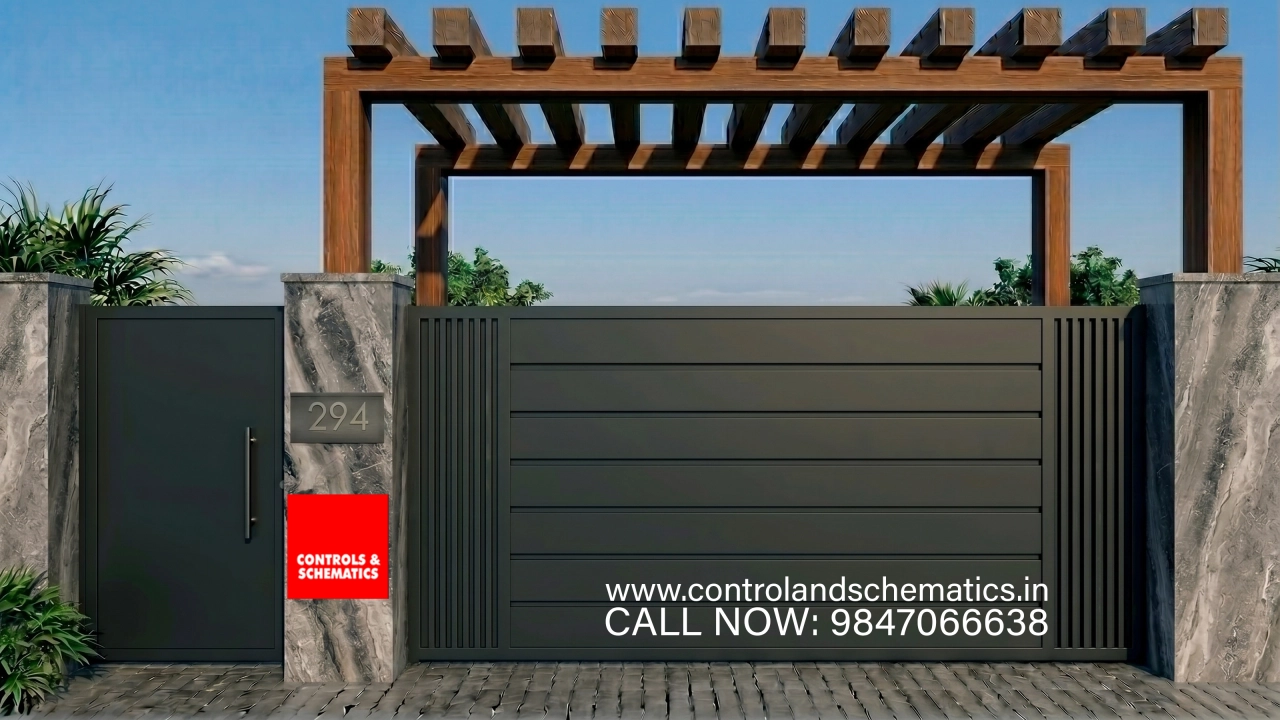
Choosing between a sliding gate and a swing gate is one of the most important decisions when planning a new entrance gate.
Both options can provide security, privacy and visual appeal. However, their performance depends heavily on site conditions such as driveway length, road width, ground slope, available side space and vehicle movement.
For Kerala homes, the decision also needs to consider monsoon rain, drainage, soil movement, humidity and coastal exposure.
The comparison between sliding gates vs swing gates is not simply about choosing the more modern option. A sliding gate may be ideal for one property and completely impractical for another. The same applies to swing gates.
This guide compares sliding and swing gates based on space, cost, maintenance, automation, safety, architecture and suitability for different types of Kerala homes.
What Is a Sliding Gate?
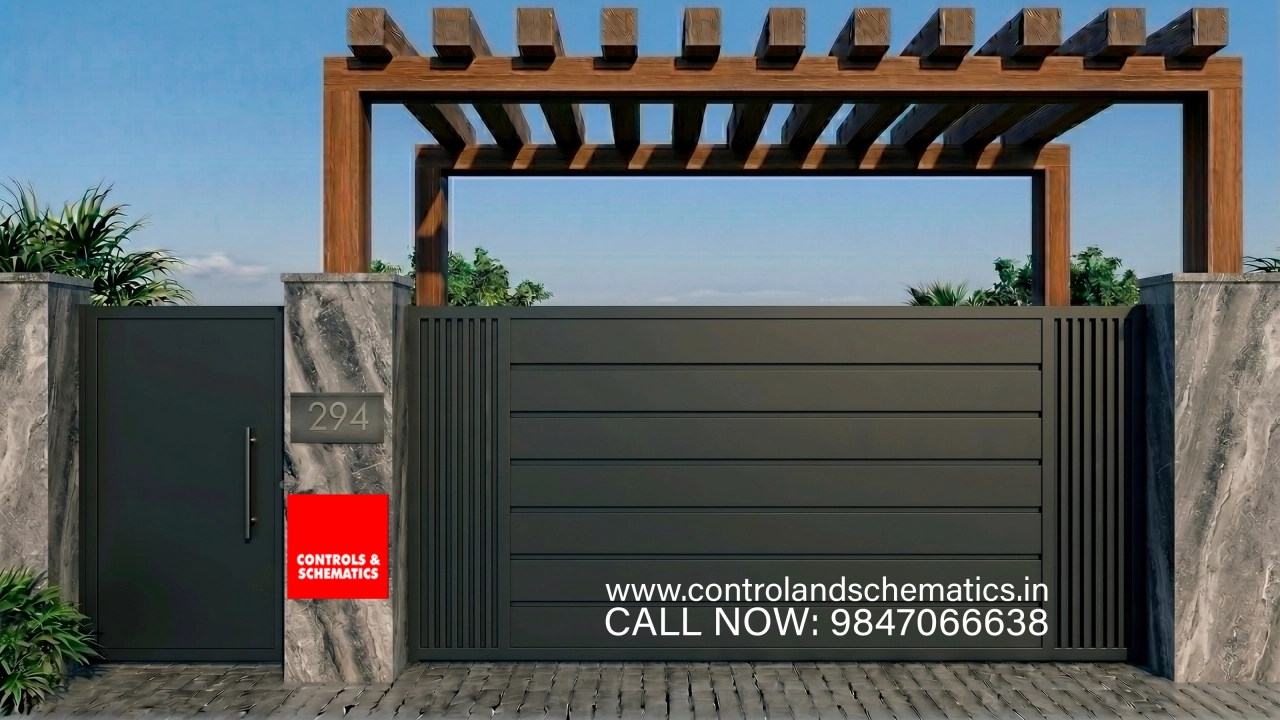
Sliding gate design
A sliding gate moves horizontally along the boundary wall.
Instead of opening inward or outward, the gate travels sideways using a track, rollers or a cantilever system.
Sliding gates may be designed as:
- Single-panel sliding gates
- Telescopic sliding gates
- Track-based sliding gates
- Cantilever sliding gates
- Automatic sliding gates
- Manual sliding gates
- Solid privacy gates
- Slatted gates
- Laser-cut gates
- Mild steel sliding gates
- Stainless steel sliding gates
- Aluminium sliding gates
Sliding gates are popular in urban homes because they do not require inward opening space.
What Is a Swing Gate?
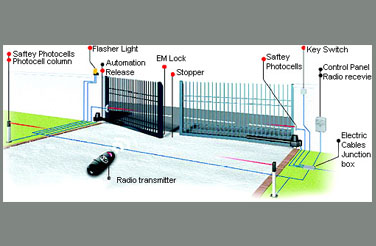
A swing gate opens on hinges, similar to a door.
It may be fabricated as:
- Single-leaf swing gate
- Double-leaf swing gate
- Equal double gate
- Asymmetrical swing gate
- Inward-opening gate
- Outward-opening gate
- Manual swing gate
- Automatic swing gate
- Traditional decorative gate
- Modern minimalist gate
Swing gates are commonly used in traditional and residential properties where adequate driveway space is available.
Sliding Gates vs Swing Gates: Quick Comparison
| Factor | Sliding Gate | Swing Gate |
| Opening direction | Sideways | Inward or outward |
| Driveway space needed | Low | High |
| Side clearance needed | High | Low |
| Suitability for slope | Usually better | Can be difficult |
| Installation complexity | Higher | Lower |
| Maintenance | Track and rollers | Hinges and latches |
| Automation | Highly suitable | Also suitable |
| Traditional appearance | Possible | Naturally suitable |
| Modern appearance | Excellent | Excellent |
| Initial cost | Often higher | Often lower |
| Wind resistance | Good with proper frame | Depends on leaf size |
| Daily convenience | High | High with enough space |
| Drainage sensitivity | High for track systems | Lower |
| Best for compact homes | Usually yes | Only if space allows |
Space Requirements
Space is usually the deciding factor.
Sliding Gate Space Requirements
A sliding gate needs clear space along one side of the boundary wall.
The side space should be at least equal to the gate opening width for a standard single-panel gate.
For example, if the entrance opening is wide, the property must provide enough side clearance for the entire gate panel to move fully.
A sliding gate is suitable when:
- The driveway is short
- Vehicles park close to the entrance
- The property is close to the road
- Inward opening space is limited
- The road outside is narrow
- The gate should not obstruct the driveway
Swing Gate Space Requirements
A swing gate requires a clear arc for opening.
For an inward-opening swing gate, the driveway must have enough depth so that the gate does not hit:
- Parked vehicles
- Steps
- Landscaping
- Drainage channels
- Walls
- Car porches
- Pedestrian paths
A swing gate may not work well when the house or parking area is close to the entrance.
Which Gate Is Better for Small Properties?
Sliding gates are usually better for compact urban plots.
They keep the driveway clear and allow vehicles to park closer to the entrance.
Swing gates may work in small properties only if the gate leaves are narrow and there is enough inward space.
Road Width and Vehicle Turning
The width of the road outside the property affects how easily vehicles enter.
Sliding Gates on Narrow Roads
Sliding gates are helpful on narrow roads because they can open fully without creating an obstruction.
They allow the driver to use the available turning space more efficiently.
Swing Gates on Narrow Roads
Swing gates can become inconvenient when the driveway entrance is narrow.
The gate leaves may reduce the usable turning area when they are open.
Outward-opening gates may extend into the road, which can be unsafe and may not be permitted depending on site conditions.
Driveway Slope
Kerala homes often have sloped entrances because of changing road levels and drainage requirements.
Sliding Gates on Slopes
Sliding gates are generally more suitable when the driveway slopes upward from the road.
Because the gate moves sideways, it does not need to clear the rising ground in front of it.
However, the gate’s sliding path itself should be properly levelled.
Swing Gates on Slopes
A swing gate can face difficulty when the ground rises in the opening direction.
The bottom of the gate may touch the driveway while opening.
Possible solutions include:
- Opening outward where safe and legal
- Increasing ground clearance
- Using specially designed rising hinges
- Modifying the driveway
- Choosing a sliding gate
Excessive ground clearance can reduce privacy and allow pets to pass underneath.
Which Gate Is Better for a Sloping Driveway?
A sliding gate is usually the more practical option.
The site should still be measured carefully to confirm that sufficient side space is available.
Structural Requirements
Sliding Gate Structure
A sliding gate requires:
- Rigid main frame
- Strong bottom rail or cantilever frame
- Suitable rollers
- Guide brackets
- End stops
- Receiving post
- Level sliding path
- Strong foundation for track or support system
Long sliding gates must be reinforced to prevent sagging or bending.
Swing Gate Structure
A swing gate requires:
- Strong gate leaves
- Heavy-duty hinges
- Reinforced pillars
- Ground or centre stops
- Locking arrangement
- Correct hinge alignment
Large swing gates place substantial force on the supporting pillars.
Pillar strength is especially important for solid and decorative gates.
Gate Weight
Gate weight affects ease of use, hardware and maintenance.
Sliding Gate Weight
The weight is carried by rollers or a cantilever support system.
A properly designed sliding gate can handle large openings.
However, poor-quality rollers or weak tracks can create difficult movement.
Swing Gate Weight
The weight is concentrated on the hinges and pillars.
Heavy gate leaves may:
- Sag
- Pull the pillars
- Become difficult to open
- Damage hinges
- Misalign locks
Double-leaf gates divide the total weight and are often more practical than one large swing leaf.
Manual Operation
Manual Sliding Gates
A well-balanced sliding gate with quality rollers can be opened easily by hand.
Poor track alignment, damaged rollers or debris can make the gate difficult to move.
Manual Swing Gates
Swing gates are generally simple to operate manually.
However, heavy leaves may require significant force.
Wind can also make large swing gates difficult or unsafe to control.
Automation Suitability
Both sliding and swing gates can be automated.
Automatic Sliding Gates
Sliding gates are highly suitable for automation.
The motor typically moves the gate through a rack-and-pinion mechanism or another drive system.
Advantages include:
- Smooth operation
- Easy remote access
- Suitability for heavy gates
- Convenient vehicle entry
- No need to leave the vehicle during rain
Automatic Swing Gates
Swing gates can be automated using arm motors, underground motors or other mechanisms.
They require:
- Sufficient opening space
- Strong hinges
- Correct gate alignment
- Suitable pillar dimensions
- Controlled opening stops
Which Gate Is Better for Automation?
Sliding gates are often considered more straightforward for automation, especially for wide entrances and frequent use.
Swing gate automation can also work effectively when the gate structure and site are suitable.
Safety Considerations
Automatic and manual gates should be designed safely.
Sliding Gate Safety
Potential risks include:
- Crushing points near the receiving post
- Trapping between the moving gate and wall
- Exposed rollers
- Sudden movement
- Poorly placed guide brackets
Safety sensors and controlled stops are important for automated gates.
Swing Gate Safety
Potential risks include:
- Large opening arcs
- Vehicle contact
- Wind-driven movement
- Pinch points near hinges
- Children standing in the swing path
Automatic swing gates should use appropriate safety sensors and opening controls.
Wind Performance
Kerala experiences strong winds during monsoon periods and storms.
Sliding Gates in Wind
Sliding gates generally remain more stable during opening because they move parallel to the boundary.
However, solid sliding gates still experience wind pressure when closed.
The frame and support system must be strong.
Swing Gates in Wind
Large swing gate leaves can act like sails.
Strong wind may:
- Push the gate suddenly
- Damage hinges
- Slam the gate
- Make manual operation difficult
- Stress automation systems
Open or slatted designs reduce wind pressure.
Privacy Options
Both gate types can provide any level of privacy.
Sliding Gate Privacy Designs
Suitable options include:
- Solid metal panels
- Horizontal slats
- Vertical slats
- Wood-finish panels
- Laser-cut sheets
- Perforated screens
- Mixed-material sections
Sliding gates work particularly well for wide privacy-focused entrances.
Swing Gate Privacy Designs
Swing gates can also use:
- Solid lower panels
- Fully covered leaves
- Decorative screens
- Closely spaced bars
- Wood or composite inserts
The additional panel weight must be considered during hinge selection.
Appearance and Architecture
Sliding Gates for Modern Homes
Sliding gates naturally suit contemporary villas.
Popular designs include:
- Horizontal slats
- Matte black panels
- Geometric sections
- Minimalist frames
- Wood-finish inserts
- Laser-cut panels
- Asymmetrical designs
Sliding Gates for Traditional Homes
Sliding gates can still suit traditional homes when designed with:
- Decorative mild steel patterns
- Wood-style panels
- Curved sections
- Antique finishes
- Traditional colours
Swing Gates for Traditional Homes
Swing gates are strongly associated with classic residential entrances.
They suit:
- Tiled-roof homes
- Nalukettu-inspired houses
- Heritage villas
- Homestays
- Traditional compounds
Double-leaf symmetry often enhances the traditional appearance.
Swing Gates for Modern Homes
Modern swing gates can use:
- Large plain panels
- Vertical slats
- Minimalist geometry
- Black-and-wood combinations
- Clean asymmetrical sections
Both opening types can be adapted to modern or traditional architecture.
Installation Complexity
Sliding Gate Installation
Sliding gates require more site preparation.
Installation may involve:
- Track foundation
- Side clearance
- Roller alignment
- Guide post installation
- Drainage around the track
- Electrical preparation for automation
- Accurate levelling
Cantilever systems may require additional structural support and specialised hardware.
Swing Gate Installation
Swing gates are usually simpler to install.
The main requirements are:
- Strong pillars
- Correct hinge placement
- Level alignment
- Adequate opening clearance
- Secure stops
- Reliable locks
Which Is Easier to Install?
Swing gates are generally easier and faster to install.
Sliding gates require more precise groundwork and alignment.
Cost Comparison
The cost depends on design, material, dimensions and hardware.
Sliding Gate Cost Factors
Sliding gates may cost more because they require:
- Longer structural frame
- Roller systems
- Track or cantilever hardware
- Guide supports
- Additional side structure
- More complex installation
- Automation equipment where applicable
Swing Gate Cost Factors
Swing gates are often more economical because they use:
- Hinges
- Stops
- Locks
- Simpler supports
- Less groundwork
However, very large or decorative swing gates can also become expensive.
Which Gate Is More Affordable?
Swing gates are usually more affordable for standard residential entrances.
Sliding gates may justify the higher cost when space, slope or convenience makes them the better choice.
Maintenance Requirements
Sliding Gate Maintenance
Maintenance may include:
- Cleaning tracks
- Checking rollers
- Inspecting guide brackets
- Removing mud and leaves
- Lubricating moving parts
- Checking motor racks
- Correcting alignment
- Inspecting drainage
Track-based systems require special attention during monsoon.
Swing Gate Maintenance
Maintenance may include:
- Lubricating hinges
- Checking sagging
- Tightening fasteners
- Maintaining locks
- Inspecting pillar movement
- Repainting damaged areas
- Checking ground stops
Which Gate Requires Less Maintenance?
Swing gates generally have fewer moving components.
However, a sliding gate with quality hardware and good drainage can also remain reliable.
Maintenance depends heavily on fabrication and installation quality.
Kerala Monsoon Considerations
Monsoon conditions can affect both gate systems.
Sliding Gate Monsoon Issues
Possible problems include:
- Mud in the track
- Water accumulation
- Leaves and stones blocking movement
- Corrosion near the lower frame
- Motor exposure
- Foundation settlement
The sliding path should have proper drainage.
Swing Gate Monsoon Issues
Possible problems include:
- Hinge corrosion
- Gate sagging
- Soil movement near pillars
- Water accumulation at the gate stop
- Swelling of wooden inserts
- Wind-related movement
Both gate types need suitable coatings and weather-resistant hardware.
Track-Based vs Cantilever Sliding Gates
Track-Based Sliding Gates
The gate moves on wheels along a ground track.
Advantages:
- Common and cost-effective
- Suitable for many residential properties
- Can handle large gates
- Easy to understand and service
Limitations:
- Track can collect dirt
- Requires regular cleaning
- Drainage is important
- Uneven settlement can affect movement
Cantilever Sliding Gates
The gate is suspended above the ground and supported from one side.
Advantages:
- No ground track across the entrance
- Better for areas with mud or heavy rain
- Smoother vehicle movement
- Reduced track blockage
Limitations:
- Higher cost
- Requires stronger support foundation
- Needs more side space
- Requires specialised hardware
Which Sliding System Is Better for Kerala?
A cantilever system may be beneficial where heavy rain, mud or drainage makes ground tracks difficult to maintain.
A well-installed track-based system can still work effectively for most homes.
Single-Leaf vs Double-Leaf Swing Gates
Single-Leaf Swing Gate
Suitable for:
- Narrow entrances
- Light gates
- Pedestrian access
- Compact openings
Limitations:
- Greater load on one pillar
- Large opening arc
- More difficult for wide entrances
Double-Leaf Swing Gate
Suitable for:
- Standard residential driveways
- Traditional gates
- Wider openings
- Balanced visual appearance
Advantages:
- Divides weight
- Reduces opening radius
- Easier manual handling
- Symmetrical appearance
Which Is Better?
Double-leaf swing gates are usually more practical for residential vehicle entrances.
Gates for Different Property Types
Compact Urban Homes
Best option: Sliding gate
Why:
- Saves driveway space
- Works near the road
- Supports privacy panels
- Easy to automate
Large Traditional Homes
Best option: Double-leaf swing gate
Why:
- Classic appearance
- Suitable for decorative designs
- Works well with large pillars
- Creates a formal entrance
Modern Villas
Best option: Either
Choose sliding for space efficiency and a sleek appearance.
Choose swing for symmetry and simpler installation.
Sloping Properties
Best option: Sliding gate
It avoids ground-clearance issues during opening.
Coastal Homes
Best option: Either, with suitable material and coating
Focus on corrosion-resistant hardware and regular maintenance.
Commercial Entrances
Best option: Sliding gate
It often suits wide openings and frequent vehicle use.
Homestays and Resorts
Best option: Swing gate for traditional character or sliding gate for operational convenience.
Pet-Friendly Homes
The gate should have:
- Small bottom clearance
- Controlled bar spacing
- Secure locks
- No climbable openings
- Safe movement
Sliding gates may be easier to design with consistent bottom clearance.
Children and Elderly Residents
Consider:
- Easy manual operation
- Automation
- Safety sensors
- No sharp edges
- Controlled closing speed
- Pedestrian access
- Emergency manual release
Pedestrian Gate Integration
Both systems can include separate pedestrian access.
Sliding Gate with Pedestrian Gate
The pedestrian gate is usually installed beside the sliding gate.
This is the preferred approach because placing a door inside the sliding panel may add complexity.
Swing Gate with Pedestrian Access
Options include:
- Separate side gate
- One smaller swing leaf
- Integrated wicket gate
- Asymmetrical double gate
A separate pedestrian gate usually provides better convenience and structural performance.
Automation and Power Failure
Automatic gates should include a manual release.
During power failure, the user should be able to open the gate safely.
Backup options may include:
- Battery systems
- Manual release keys
- Inverter connection
- Emergency access arrangements
The motor and electrical controls should be protected from rain and water accumulation.
Security Comparison
Both gate types can provide good security.
Sliding Gate Security
Sliding gates are difficult to force open when they use:
- Strong receiving posts
- Secure guide systems
- Motor locking
- Anti-lift devices
- Proper end stops
Swing Gate Security
Swing gates can be secured using:
- Centre locks
- Ground bolts
- Drop rods
- Automation locks
- Strong latches
- Reinforced hinges
The locking system matters more than the opening type alone.
Common Mistakes to Avoid
Choosing a Sliding Gate Without Side Clearance
The gate needs enough space to move completely.
Choosing a Swing Gate for a Short Driveway
The gate may hit vehicles or reduce usable parking.
Ignoring Driveway Slope
Swing gates may scrape the ground.
Poor Track Drainage
Water and mud can affect sliding gate movement.
Weak Gate Pillars
Heavy swing gates can damage inadequately reinforced pillars.
Using Low-Quality Rollers
Poor rollers make sliding gates noisy and difficult to operate.
Ignoring Wind Load
Solid swing gates can become unsafe in strong wind.
Planning Automation Too Late
Electrical conduits and motor foundations should be considered during construction.
Forgetting Pedestrian Access
Opening the full vehicle gate for every person is inconvenient.
Choosing Design Over Practicality
The gate should work smoothly every day, not just look attractive.
How to Choose the Right Gate
Ask these questions before deciding:
Is there enough driveway depth?
If no, consider a sliding gate.
Is there enough side space?
If no, a swing gate may be necessary.
Does the driveway slope upward?
A sliding gate is usually better.
Is the road narrow?
Sliding gates often improve vehicle access.
Is the property traditional or modern?
Both types can be customised, but swing gates naturally suit traditional homes.
Is automation required?
Both can be automated, but sliding gates are often preferred for frequent use.
What is the maintenance preference?
Swing gates have simpler hardware. Sliding tracks require regular cleaning.
Is privacy important?
Both can use solid or semi-solid panels.
Is the property exposed to strong wind?
Consider gate weight, panel design and opening behaviour.
What is the budget?
Swing gates are usually more economical initially.
Frequently Asked Questions
Which is better, sliding gates or swing gates?
The better option depends on driveway space, side clearance, slope, road width and budget. Sliding gates suit compact properties, while swing gates suit homes with enough inward space.
Are sliding gates suitable for Kerala homes?
Yes. Sliding gates are suitable for urban homes, short driveways and sloping entrances. Proper drainage is important.
Are swing gates cheaper than sliding gates?
Swing gates are usually more affordable because they require simpler hardware and installation.
Which gate is better for a sloping driveway?
A sliding gate is usually better because it does not need to swing over rising ground.
Do sliding gates need more maintenance?
Track-based sliding gates need regular track cleaning and roller inspection. Swing gates mainly require hinge and alignment maintenance.
Which gate is better for automation?
Both can be automated. Sliding gates are often preferred for wide entrances and frequent vehicle movement.
Can sliding gates suit traditional homes?
Yes. Sliding gates can use decorative patterns, wood finishes and traditional colours.
Are swing gates safe in strong wind?
Large swing gate leaves can move suddenly in strong wind. Proper stops, automation and open-panel designs can reduce risk.
How much side space does a sliding gate need?
A standard sliding gate usually needs side space approximately equal to the entrance width.
Can a swing gate open outward?
It may be possible, but it should not obstruct the road, footpath or public area. Site conditions and local requirements must be checked.
Which gate is best for a narrow road?
Sliding gates are often better because they do not reduce the driveway turning area.
Is a cantilever sliding gate better than a track gate?
Cantilever gates avoid ground tracks and can perform better in muddy or rainy locations, but they cost more and need stronger support.
Can both gate types include pedestrian access?
Yes. A separate pedestrian gate can be installed beside either system.
Which gate is best for a modern villa?
Both can work. Sliding gates create a sleek and space-efficient entrance, while swing gates offer symmetry and simpler installation.
What should be planned before gate fabrication?
Confirm the entrance width, slope, side clearance, driveway depth, gate material, privacy, pedestrian access, automation and pillar strength.
Sliding and Swing Gate Fabrication by Shades & Structures
The right gate system should be selected according to the actual site rather than appearance alone.
Shades & Structures provides customised sliding and swing gate design and fabrication solutions for homes, villas and commercial properties.
Each project can be planned based on:
- Entrance dimensions
- Driveway depth
- Side clearance
- Road width
- Ground slope
- Vehicle movement
- Property architecture
- Mild steel or stainless steel preference
- Privacy requirements
- Manual or automatic operation
- Pedestrian access
- Pillar and boundary wall condition
- Kerala weather exposure
The objective is to create a gate that is visually suitable, structurally strong and convenient for everyday use.
Conclusion
The decision between sliding gates and swing gates depends mainly on the property layout.
Sliding gates are ideal for short driveways, narrow roads, sloping entrances and modern homes where space efficiency is important. They require adequate side clearance and proper track maintenance.
Swing gates are suitable for homes with enough inward space. They are simpler, often more economical and naturally suit traditional residential entrances.
Neither option is automatically better for every home.
The best approach is to evaluate the entrance width, road level, driveway slope, parking position, side clearance, gate weight and future automation requirements before fabrication begins.
For professional guidance on sliding gates vs swing gates, Shades & Structures can assess your entrance and recommend the most practical configuration.
Contact Shades & Structures to discuss a customised sliding or swing gate for your home, villa or commercial property.